About Old Coach Road
Exploring Today
What to Do
The Local Area
Extra Info
Hapuawhenua Viaduct
The first Hapuawhenua Viaduct was classified as a Category 1 structure by Historic Places Trust in October 1995.
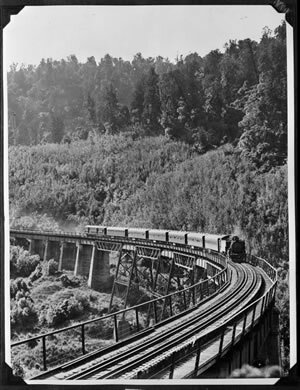
The viaduct became redundant when a new concrete railway viaduct was completed in 1987. From Ohakune, the railway line has to climb around 500ft up to Horopito.
The railway tracks climb on a 1:50 grade for most of the way, a steep climb for steam locomotives. A viaduct was needed to cross the Hapuawhenua valley.
Peter Seton Hay designed a curved steel lattice viaduct with 13 concrete piers and four steel towers on concrete foundations. Fred Furkett was the engineer in charge its construction. The viaduct is 284 metres long, 45 metres above the stream and built on a 10 chain radius curve with a level deck.
Building materials were brought to the site from the present Ohakune railway yard, along a temporary tramway below the planned permanent level.
By building a temporary tramway to carry materials and supplies, the tunnel, the Hapuawhenua Viaduct and the permanent way could all be worked on at the same time.
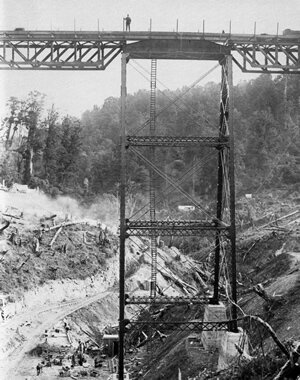
A short branch line off this Hapuawhenua tramway led to the Ohakune railhead station in the bush, where passengers boarded coaches to continue their journey.
The steel girders for the viaduct were made at Mangaonoho, north of Taihape, then railed to Ohakune.
The steel work was assembled at ground level on site, and the towers erected on concrete foundations.
The steel girders connecting the tower tops were then hauled up by derrick poles fitted on top of the steel towers.
A flying fox system for carrying materials along the length of the viaduct could not be used as this viaduct was curved.
It is surprising to learn that scaffolding was not used.
The builders used ladders reaching from the foundations to deck level, about 45 metres above the stream. Construction was completed with no serious injuries.
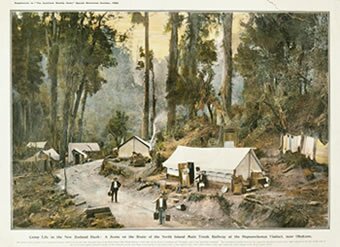
Hapuawhenua Viaduct Workers Camp
During the 9 weeks following August 9th, 1907, there were only 5 days without rain. Working conditions were not pleasant, especially during the cold freezing winter.
The new replacement concrete viaduct was opened on May 2nd 1987.
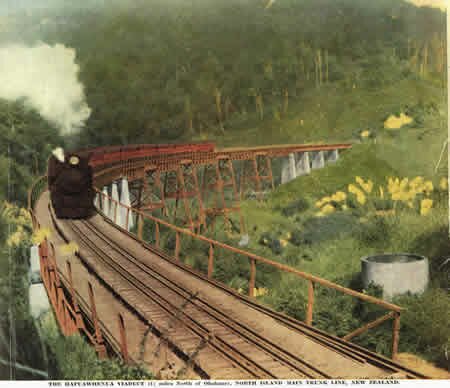
Hapuawhenua Viaduct with North Bound Train
A J Hackett ran New Zealand's first bungy jump off the old Hapuawhenua Viaduct in 1987.
Tongariro Natural History Society and Department of Conservation, with financial support from the Stout Trust, have cleaned the steel work and restored the decking on the viaduct.

The Overlander Crossing the New Hapuawhenua Viaduct
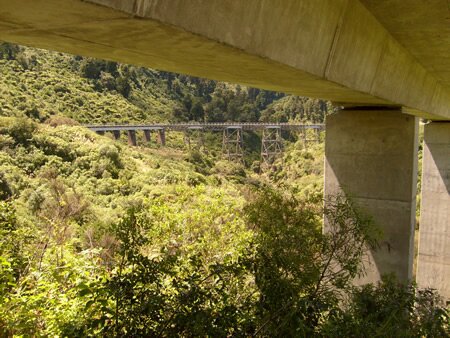
The Hapuawhenua Viaducts, Old and New
Now it is an exciting and safe experience to walk along the deck, study the construction and design of the viaduct, marvel at the new concrete viaduct and enjoy the serenity of the bush and the antics of the native birds.
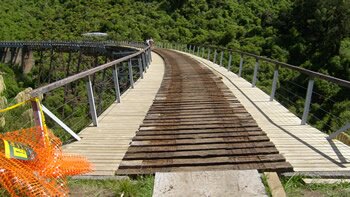
Hapuawhenua Viaduct Today